
A new table view can be created by clicking on the “+” button at the top of the Tables List in the Custom Views section.

Define Rows (Asset Types)

In the first step, specific asset/relation types for the table view can be selected, e.g. “Azure Virtual Machines” or “Azure Disks”. In the resulting table view, each single row will show an instance of the selected asset/relation types together with their properties.
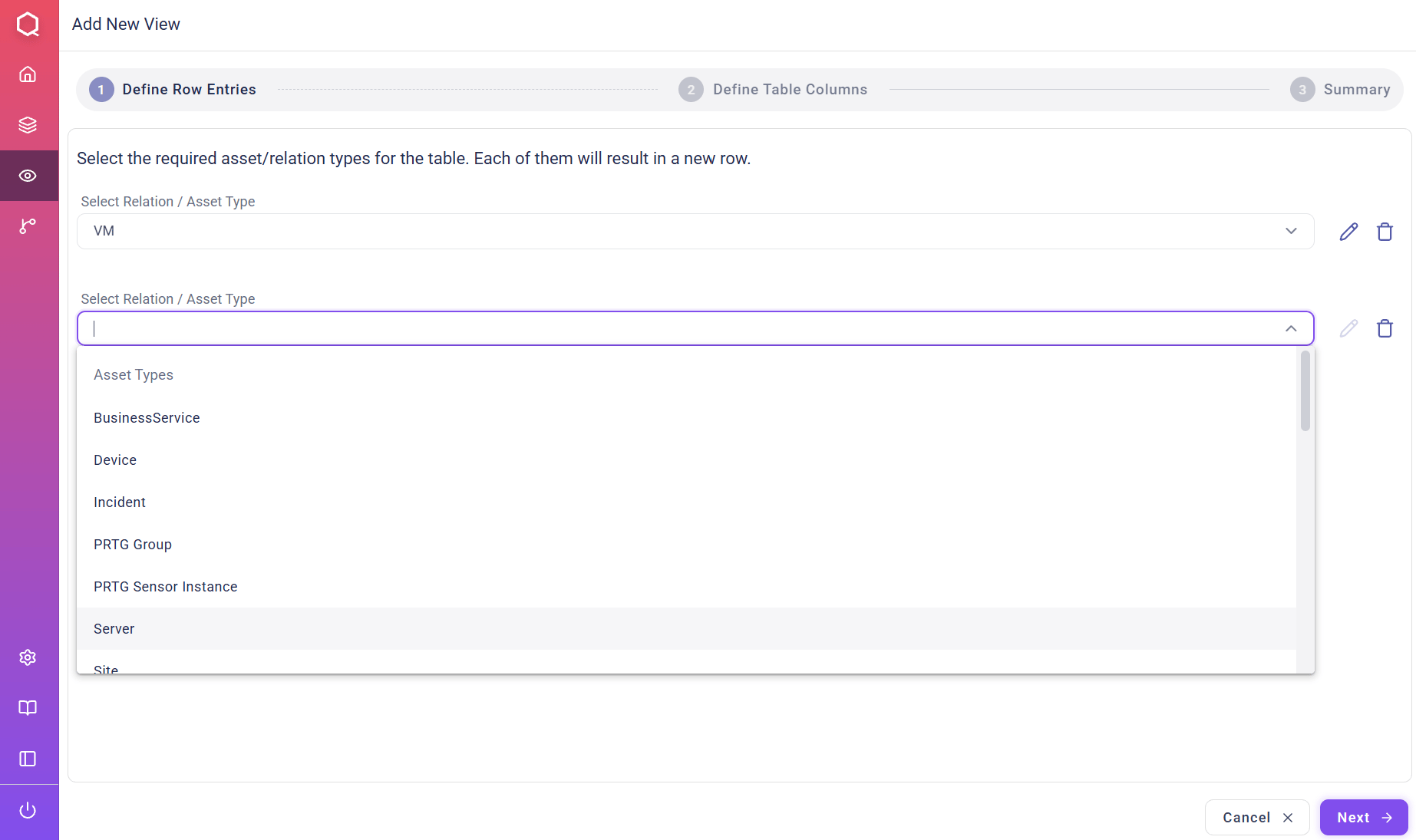
Creating Tables: Define Rows (Asset Types)
The first step is selecting the asset/relation types to be shown by the table view.

Constraints & Analysis Rules (Coloring)

It is also possible to optionally define constraints and analysis rules for the selected asset/relation types.
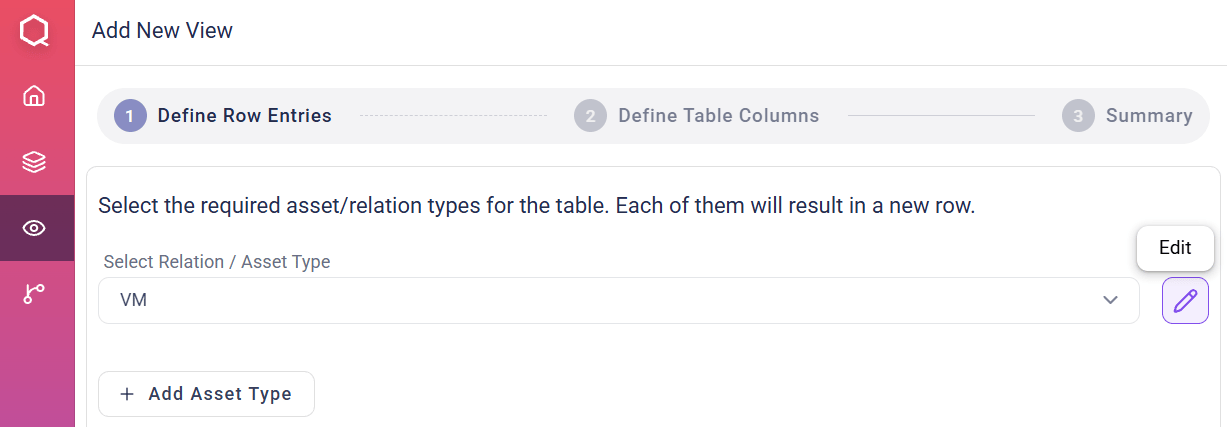
Creating Tables: Constraints & Analysis Rules (Coloring)
Defining Constraints and Analysis rules for a specific asset/relation type is possible by clicking on the “pencil” icon on the right. Constraints show only asset/relation instances that fulfill the constraints. Analysis Rules (color rules) define under which conditions asset/relation instances are shown in certain colors. They can be created by clicking the edit button (pencil icon) next to the selected type. In the appearing menu, constraints and analysis rules (coloring) can be added via the + Add Constraint and + Add Rule buttons. Using the operators (AND/OR), multiple conditions for one constraint or analysis rule can be defined.
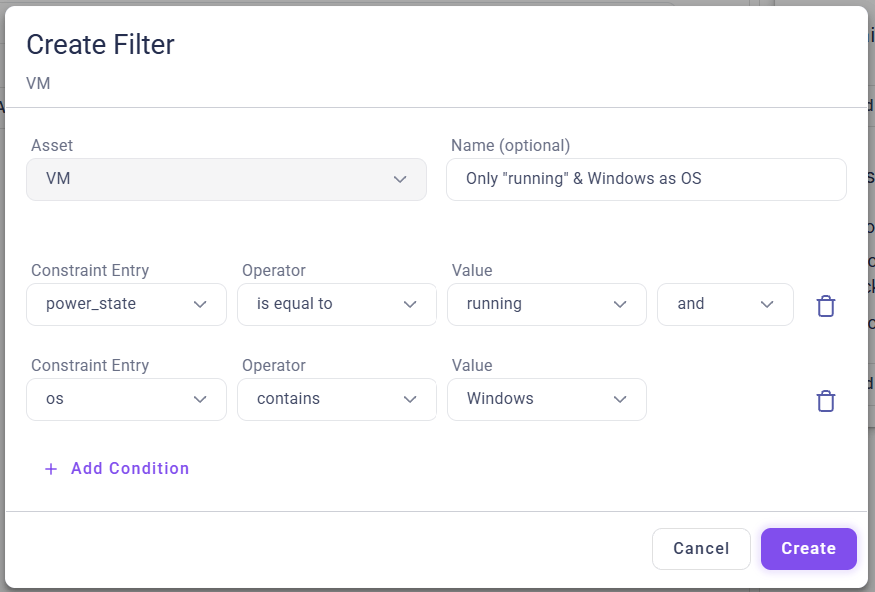
Creating Tables: Constraints & Analysis Rules (Coloring)
Example for a constraint defined for “Virtual Machines” instances.

Define Columns (Properties & Relations)

In the next step, the properties to be shown for each asset/relation are selectable, e.g. the “Name” and “Power State” of each “Virtual Machine” instance.
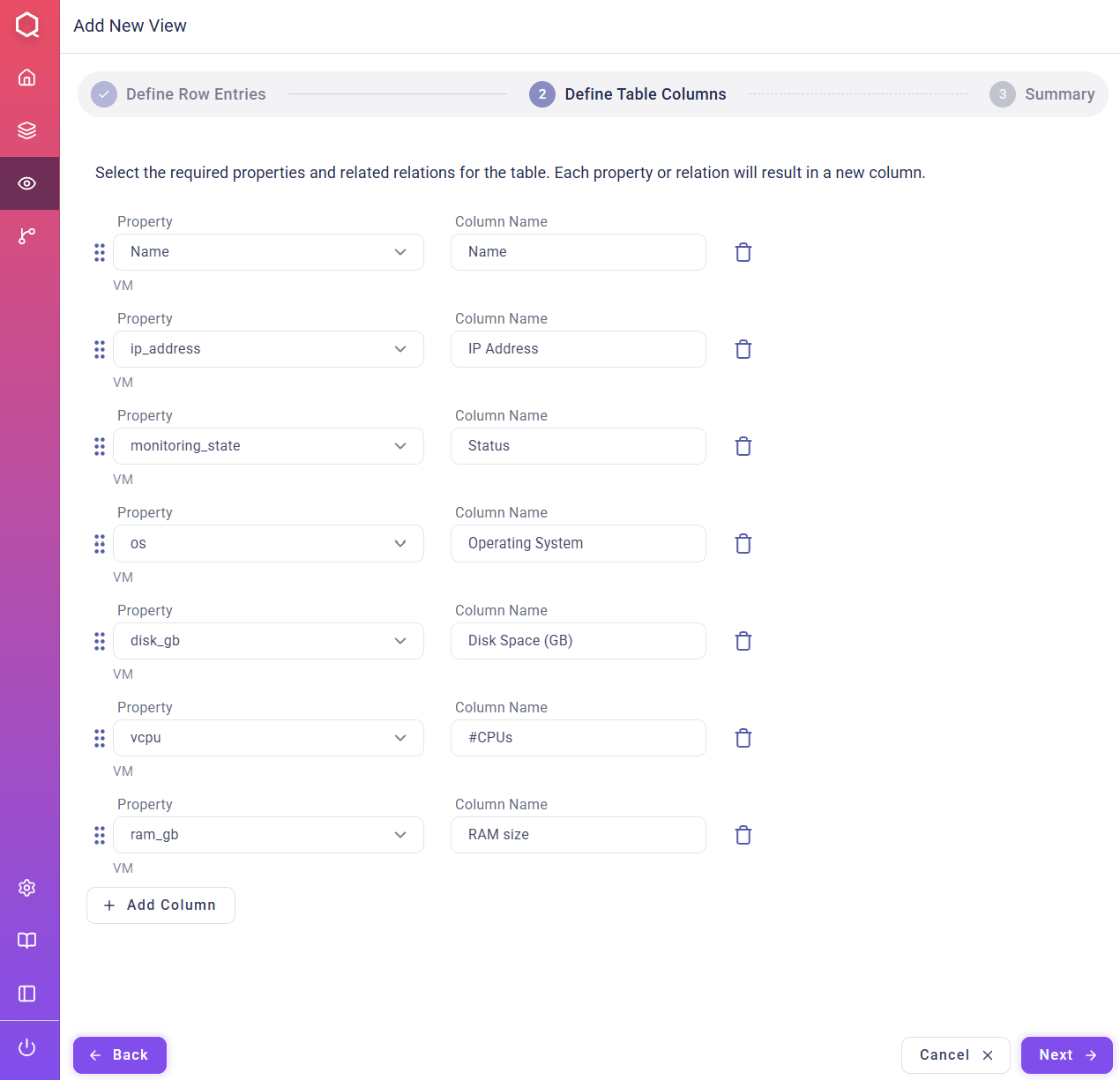
Creating Tables: Define Columns (Properties & Relations)
Column Definition Example A column can either refer to …
  • properties directly belonging to an asset/relation – such as “Name”, “First Seen” or “Power State” – or
  • relations associated with that asset/relation (see figure below).

Creating Tables: Define Columns (Properties & Relations)
Example for additionally showing properties of “neighbors” of “VMs” via its dependencies to “Servers”. In this case, the column shows the name of the server that a virtual machine is running on. Using “relations” in tables is a powerful feature, as it can deliver information which is not directly retrievable from the initially selected “types”:
  • Using relations as property of asset types:
When a table view is defined for the asset type “Virtual Machine”, the assignment of virtual machine instances to certain “Servers” can be displayed via adding the relation “hosted_on [VM→ Server]” as column as shown above.
  • Using relations directly as “type” in the initial “Define Row Entries” step (see above):
When a table view is defined for the relation type “hosted_on [VM→Server]”, using its “Source Asset Properties” and “Target Asset Properties” can quickly deliver a list of all VMs together with the servers their running on.

Table View Summary

In the “Summary” step, the final data schema of the table view is shown. As a last step, a name and an optional description for the view can be defined.
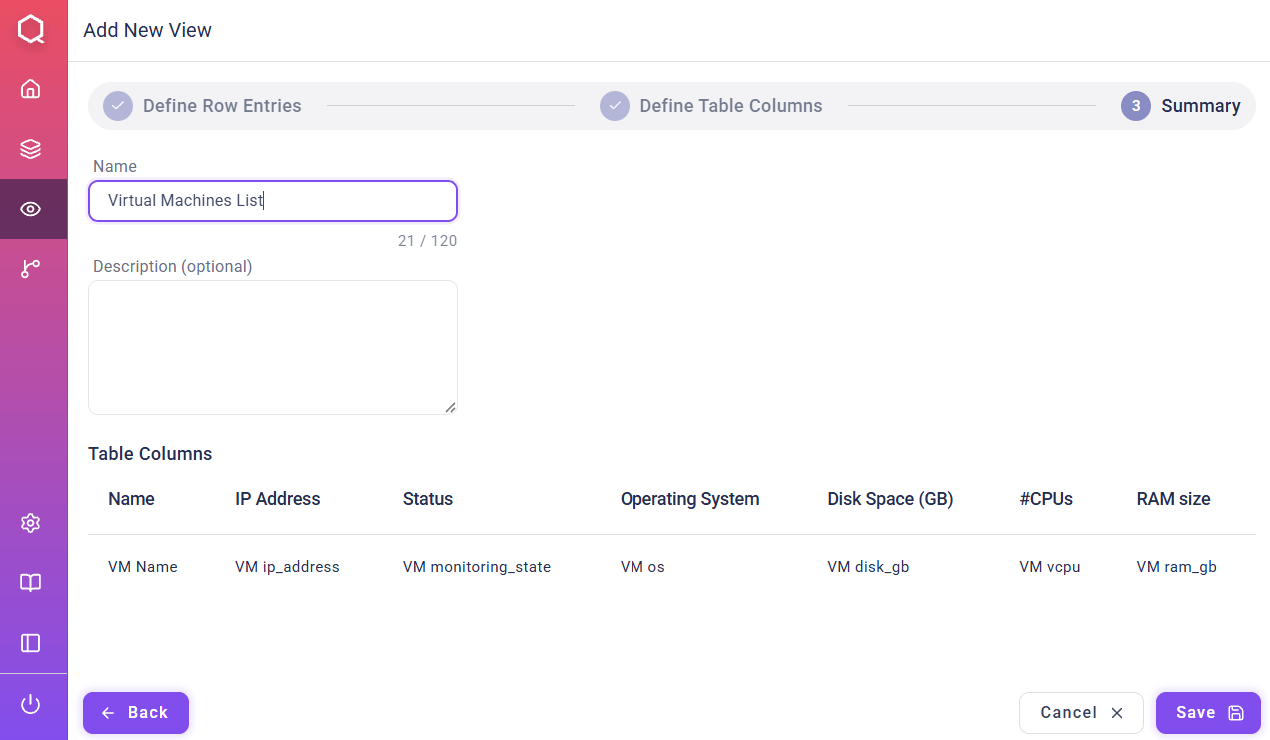
Creating Tables: Table View Summary
Table View Summary Example